
Key Takeaways
- Every "executive assistant skills" list ranking today answers a hiring or resume question. The 2026 question is different: which of these skills does AI now do for you, and which ones just became your entire value?
- The skill set splits three ways. Digital execution (calendar, inbox triage, meeting notes, drafting, recall) is the layer AI now handles. Physical logistics (travel, errands, real bookings) is still human. Judgment (anticipation, discretion, prioritization) is uniquely human.
- The mechanical layer is not hypothetically exposed. PwC's US arm cut about 600 assistants and support staff, and Deloitte, KPMG, EY, and McKinsey have trimmed similar roles (Fast Company, May 2026).
- The same McKinsey research that puts ~57% of US work hours in automation range also says social and emotional skills "will remain uniquely human" (McKinsey, Nov 2025). The skill that matters most in 2026 is knowing which layer a task sits in.
I run growth at Kai, so I am my own executive assistant: I book my own calls, triage my own inbox, and chase my own follow-ups, on top of the actual job. That is the seat this guide is written from.
Last week I needed to write up how we built our meeting-transcription free tool. The problem: I could not remember half of what we decided. The decisions were scattered across a month of calls and email threads, and I did not feel like re-reading meeting notes to reconstruct them.
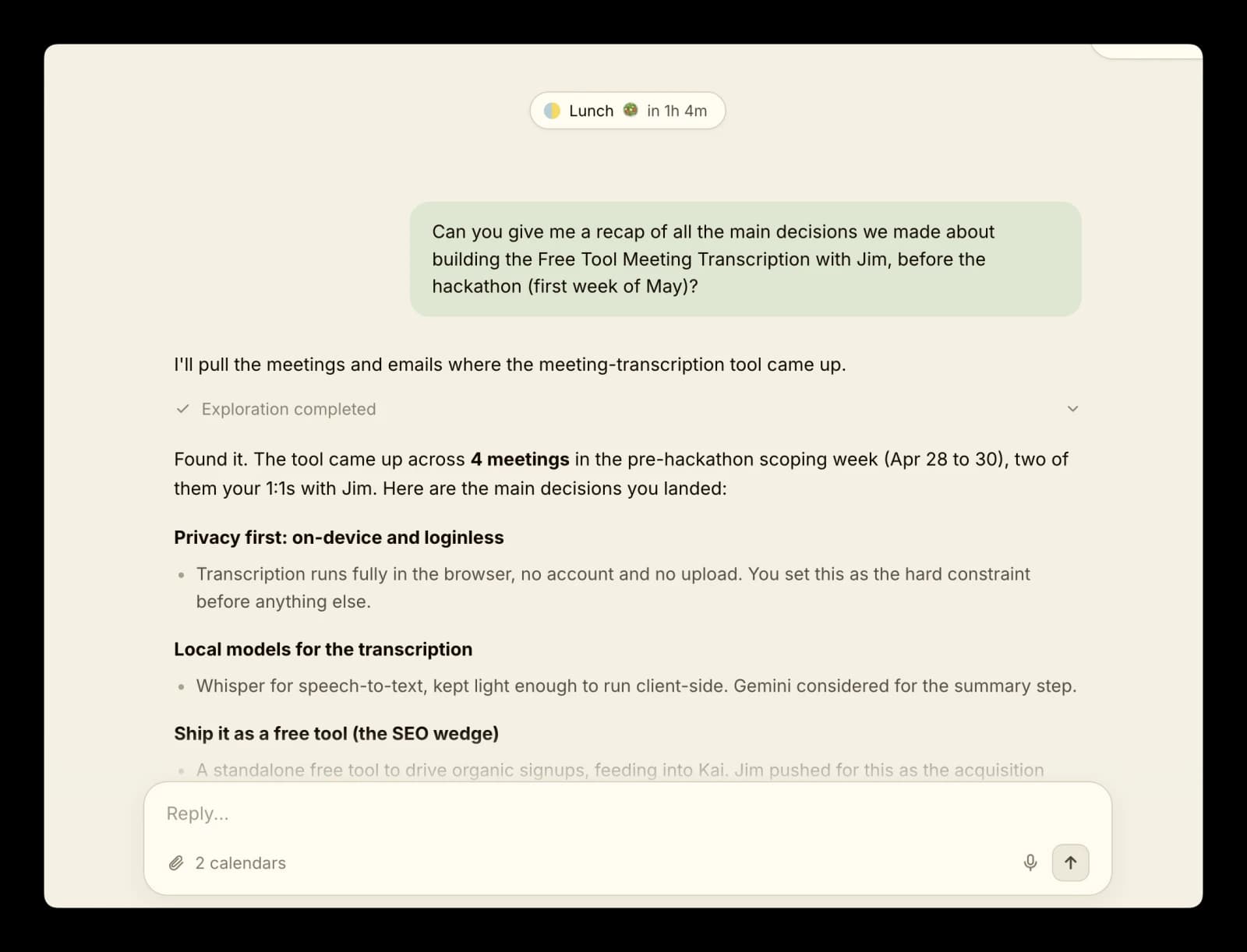
So I did not. I asked Kai, with a few keywords and the context, to pull back everything we had said about that tool and every meeting where it came up. It gave me the broad strokes in one pass. Then I used Kai's MCP to go straight into the actual transcripts and rebuild the real decision history, the parts that lived in the calls and never made it into a doc.
That used to be a skill. "Institutional memory," the thing a great executive assistant carries in their head: who decided what, when, and why. I did not exercise that skill. I delegated it.
That is the shift nobody writing about executive assistant skills in 2026 has caught up to. Search the term and you get the same article 15 times: communication, calendar management, time management, discretion, organization, attention to detail. All true. All written for someone hiring an assistant or building a resume. None of them answer the only question that actually changed: which of these skills does AI now do for you, and which ones just became the whole job?
This guide sorts the classic skills into the three layers they now belong to, and is honest about the two layers AI does not touch.
What "executive assistant skills" actually means in 2026
The role was never really about the tasks. It was about owning an executive's operational life so they could spend their attention elsewhere. The tasks were just the form that took. That gap between the visible tasks and the actual value is exactly why the role gets underrated from the outside:
“There is no way he could ever do my job. To say he'll 'just become an EA' like he would be settling for a less-than position was a bit disheartening.”
an EA in r/ExecutiveAssistantsRobert Half now frames the modern executive assistant as a "strategic partner" and notes the role is increasingly retitled "Executive Business Partner" or "Chief of Staff," with the explicit line that "understanding when to use AI and when human judgment matters more has become a valuable skill" (Robert Half). That retitling is the tell. The clerical half of the job is being abstracted away, and what is left is the part that was always the real value.
So a 2026 skills list should not be a flat catalogue. It should be sorted by who owns each skill now: you, or the AI you hand it to. Three layers.
The skills, sorted by who owns them now
Here is the classic executive assistant skill set, mapped to the three layers. This is the table the SERP does not have, because the SERP is still writing one undifferentiated list.
| Classic skill | Layer | Who owns it in 2026 |
|---|---|---|
| Calendar and scheduling coordination | Digital execution | AI-assisted. You set the rules; it does the Tetris. |
| Inbox triage and email drafting | Digital execution | AI-assisted. It sorts and pre-writes; you approve. |
| Meeting notes and action items | Digital execution | AI-assisted. Captured and structured automatically. |
| Recall and institutional memory | Digital execution | AI-assisted. Searchable across email and meetings. |
| Travel booking, errands, real-world logistics | Physical logistics | Human. AI does not act in the physical world yet. |
| Bulk inbox cleanup with real consequences | Physical logistics | Human-supervised. Delete the wrong thing and it matters. |
| Anticipation (knowing what is needed before being asked) | Judgment | Human. The defining EA skill, still uniquely human. |
| Discretion and confidentiality | Judgment | Human. Trust cannot be delegated to a tool. |
| Managing up and stakeholder read | Judgment | Human. Reading a room is not a model task. |
| Prioritization under ambiguity | Judgment | Human. Deciding what truly matters is the job. |
The rest of this guide walks each layer, with the honest version of what AI does and does not do in each.
Layer 1: the digital execution AI now handles
This is the layer that filled an assistant's day, and it is the layer that is genuinely exposed. McKinsey's November 2025 research estimates ~57% of US work hours are technically automatable with current AI, with roles heavy on "drafting documents" and administrative work among the most exposed (McKinsey). This is not a forecast. PwC's US arm cut around 600 assistants and support staff, and Deloitte, KPMG, EY, and McKinsey have trimmed or relocated similar roles over the past year (Fast Company, May 2026).
Four skills sit here.
Calendar coordination. The back-and-forth of finding a slot, protecting focus time, and rescheduling around conflicts. The people who do this all day know exactly how it feels:
“An executive assistant, sitting in front of a screen, hoping to find 30 minutes in my executive's calendar to set this meeting. That's it, that's the post.”
an EA in r/ExecutiveAssistantsThat is the part you now hand off: ask for the day to be planned, and the all-day tasks drop into real time blocks. You set the priority once and it holds. Our time blocking guide covers the discipline side; the mechanical placement is the part that delegates cleanly. For the scheduling-link tradeoff, our Calendly alternatives breakdown covers the tools.
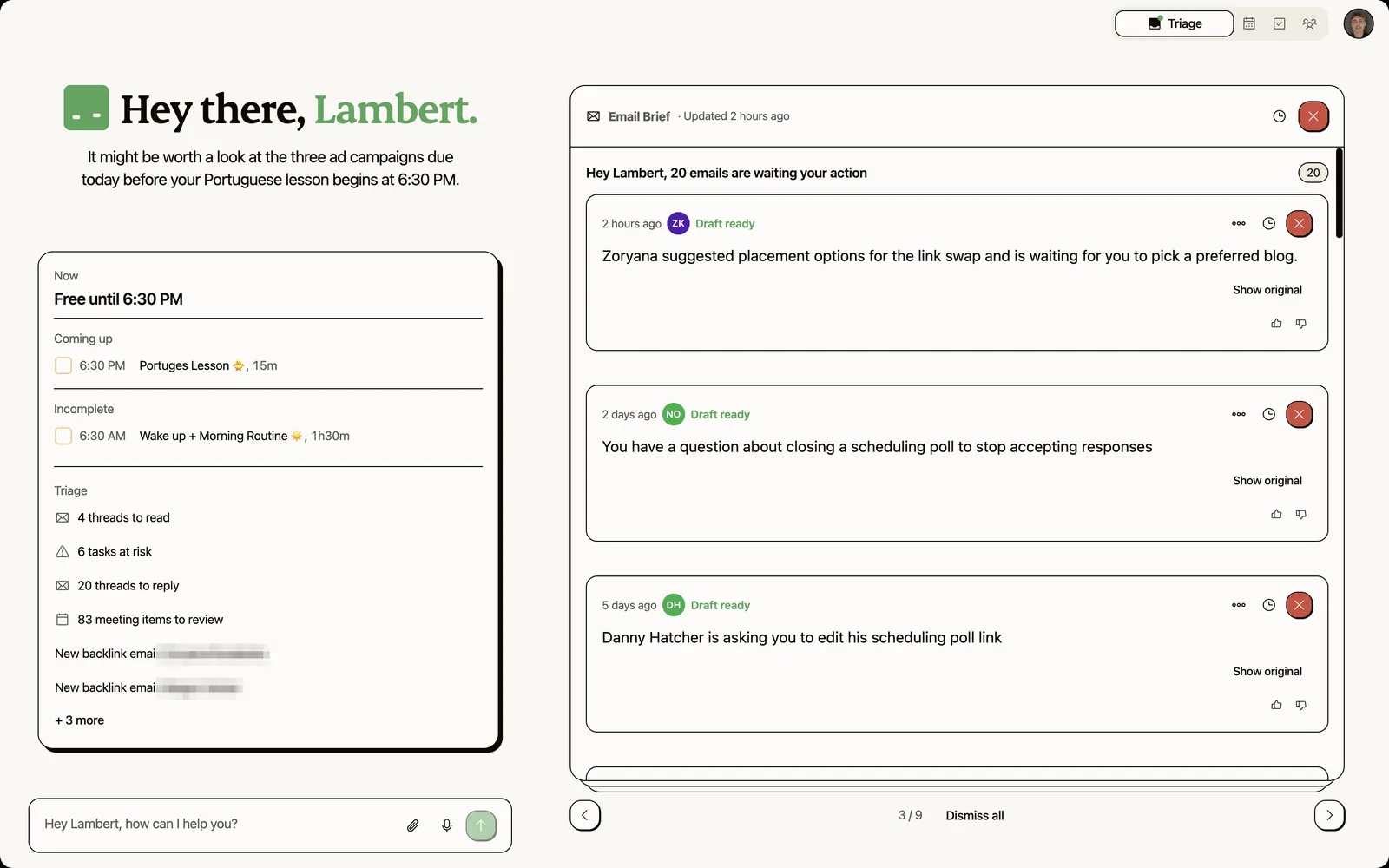
Inbox triage and drafting. Sorting what needs a reply from what is noise, then drafting the boring replies. The piece that earns its keep: the tedious replies get pre-filled in your tone, so you are editing instead of writing from scratch, and nothing sends without your approval. Our Superhuman alternatives piece covers the inbox-tool category if you want the landscape.
Meeting capture and notes. Transcripts, summaries, and action items, without a human scribbling during the call. Our how to write meeting minutes guide covers the output format, and the Otter alternatives and Granola review pieces cover the notetaker category and its visible-bot tradeoff.
Recall and institutional memory. This is the one most lists miss entirely, because until recently no tool could do it. The meeting-transcription example from the intro is the shape of it: ask in plain language for what was decided about X, get it pulled from across your email and meetings, then drill into the source transcript when you need the exact wording.
The pattern across all four: the skill did not disappear. It moved from something you do to something you supervise. That is the actual 2026 competency, and McKinsey says the same thing in its own words: "people will still be needed to guide, supervise, and verify" (McKinsey).
Layer 2: the logistics AI still can't take off your plate
Here is where the honest version matters, because this is the layer that makes people say "that is not really an assistant."
A human executive assistant books the flights, sorts the hotel, handles the visa paperwork, sends the gift, returns the package, and chases the vendor. Those tasks need an actor in the physical world with accounts, payment methods, and the judgment to know your preferences.
Software does not act in the physical world, so this layer stays human. An AI can draft the email to the travel agent. It cannot be the travel agent. The people building AI assistants say the same: today's agents "excel at narrow, well-defined tasks but struggle with broader human judgment" and cannot match a real EA's range (GeekWire). For a lot of executives that gap is the whole reason they have an assistant, so scope the tools to what they actually do and treat "book all my trips and run my errands" as still human.
The same caution applies to bulk inbox actions. Archiving or deleting at scale is easy to ask for and risky to trust, because the cost of deleting the wrong thing is high. Keep a human in the loop on anything irreversible.
Layer 3: the judgment skills that are now the whole job
Strip away the digital execution and the physical logistics, and what is left is the layer that was always the real value. In 2026 it is no longer one part of the job. It is the differentiator. Ask EAs to describe what they actually do and the mechanical tasks barely come up:
“Happy Admin Day to everyone out there quietly running things, managing up, and occasionally adding themselves to the order.”
an EA in r/ExecutiveAssistantsAnticipation. Knowing what is needed before anyone asks. Melba Duncan's foundational Harvard Business Review piece put it best years ago, and it has only gotten truer: "Microsoft will never develop software that can calm a hysterical sales manager, avert a crisis by redrafting a poorly worded email, smooth a customer's ruffled feathers, and solve a looming HR issue, all within a single hour" (HBR). An AI can surface a brief. It cannot sense that a relationship is about to go sideways.
Discretion and confidentiality. An assistant hears about layoffs, deals, and personal matters before anyone else. That is a trust relationship, and a tool cannot be held accountable the way a person can. Robert Half names "absolute discretion" as core to the role for exactly this reason (Robert Half).
Managing up and reading the room. Knowing when to push back, when to protect your executive's time, which meeting actually matters this week, how to read the politics of a decision. McKinsey classes interpersonal and emotional work as the part that "will remain uniquely human" (McKinsey).
Prioritization under ambiguity. When three things are on fire and the brief is unclear, deciding what gets dropped is judgment, not pattern-matching. AI will rank your inbox. It will not decide that the angry customer matters more than the board deck this afternoon.
The market is already pricing this. Robert Half's 2026 guide reports that 83% of administrative and customer-support leaders pay more for candidates with specialized skills, and links the premium directly to "proficiency with AI tools" plus higher-order judgment (Robert Half). The assistant who owns layer 3 and directs the AI on layer 1 is the one getting paid.
How Kai handles layer 1
We build Kai at Morgen. It is the AI executive assistant behind the workflow in the intro, and it is built to own layer 1 so your attention goes to layers 2 and 3.
Three pieces map to the skills above.
Meetings. Kai joins Zoom, Google Meet, Teams, and Slack huddles without a visible bot in the room, captures the call, and breaks it into decisions, action items with owners, and open questions. Before a meeting it assembles a brief from the last thread, the previous transcript, and open action items. After, the recall is searchable, which is the meeting-transcription example from the intro. More on the prep side in our AI meeting prep piece and the meetings page.
Email. Kai triages the inbox into a small set of categories and drafts replies in your voice for the routine ones. You accept, edit, or dismiss each one in a triage workspace before anything is sent. Nothing leaves without you.
Plan. Kai proposes a realistic daily plan, protects focus blocks, and adjusts when the day moves. The action items from your meetings flow into that plan instead of dying in a separate notes app. That cross-tool handoff is covered on the daily planning page and in our companion guide on what an AI executive assistant actually does.
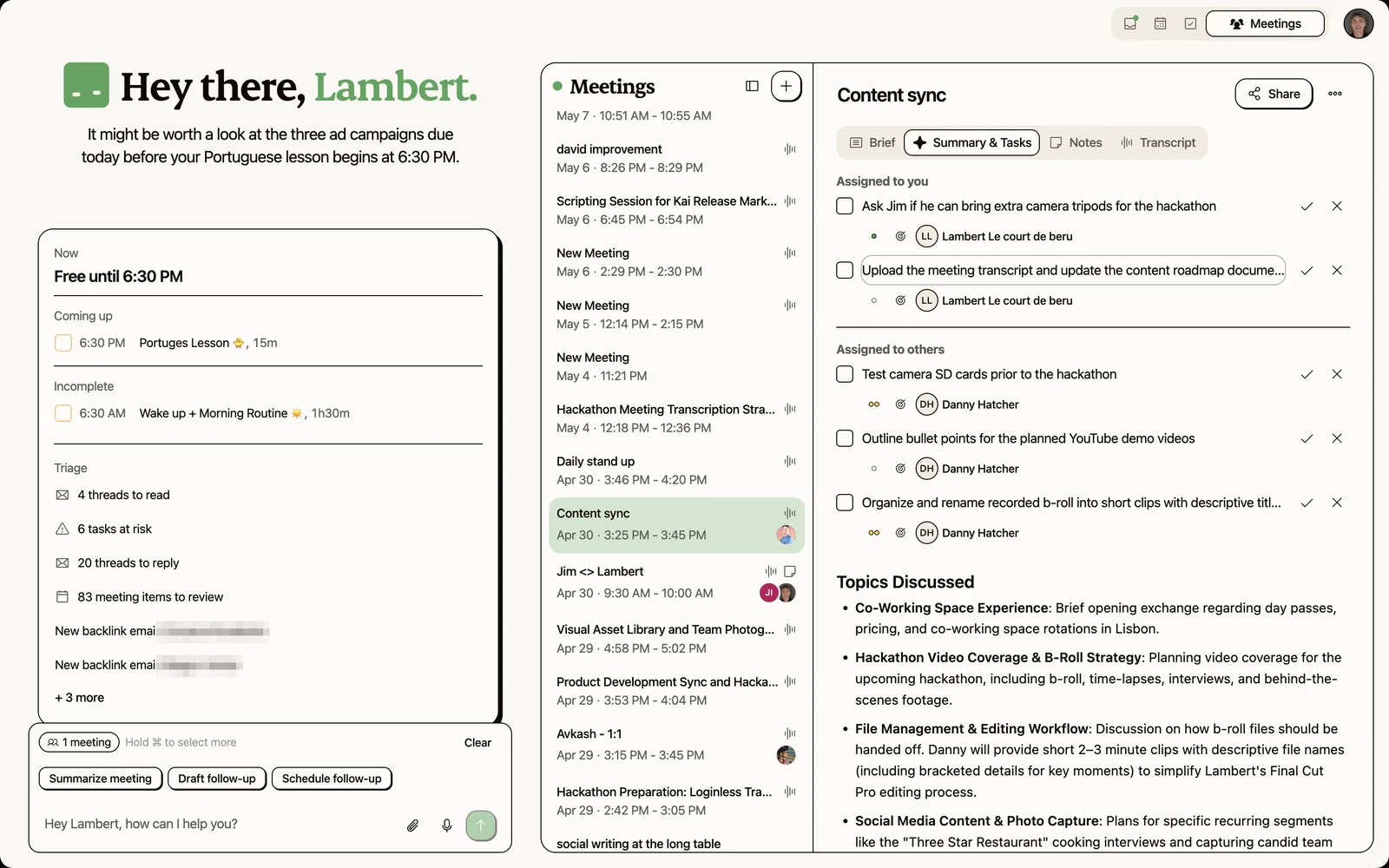
The honest limits. Kai owns layer 1. It does not touch layer 2 or layer 3, and neither does any AI assistant today. It will not book your travel, run your errands, or clean your inbox in bulk without supervision. It will not read a tense room, hold a confidence, or decide what truly matters when everything is urgent. Those are still your job, and that is the point: the tool exists to hand that time back to you, not to pretend it can do the human part. Kai is also newer than the tools it sits alongside, so the integration list is still growing.
For founders who are their own executive assistant
Most people reading this do not have an assistant. They are their own, on top of an actual job. Founders, freelancers, solo operators.
The good news in the three-layer model: layer 1 is now buyable. The calendar Tetris, the inbox triage, the meeting notes, the recall, the part that ate your evenings, can be covered by a tool. That frees your attention for the layers that were always going to be yours anyway, the judgment calls and the relationships. You will not delegate layer 3 to anyone, human or AI. But you can stop spending your best hours on layer 1.
When you still need a human executive assistant
The honest filter, because the three-layer model cuts both ways.
If your need is mostly layer 2, you need a person. Heavy travel, complex logistics, real-world coordination, the gift that has to arrive on the right day: AI does not do these. If your need is high-touch relationship management, the kind where someone has to know your world and the people in it well enough to act on your behalf, that is layer 3, and a tool augments it rather than replaces it.
The right read is not "AI replaced the executive assistant." It is "AI took the layer that was burning out assistants, and made the human layers the entire job." A great assistant with AI on layer 1 is more valuable than ever. The tool just changed what the job is made of.
FAQ
Can AI replace an executive assistant?
Not the whole role. AI now covers layer 1, the digital execution: calendar, inbox triage, meeting notes, drafting, and recall. It does not cover layer 2 (physical logistics like travel and errands) or layer 3 (judgment, discretion, anticipation, reading the room). McKinsey's own research, which puts ~57% of US work hours in automation range, also says social and emotional skills "will remain uniquely human" (source). So AI replaces a layer, not the role.
What are the most important executive assistant skills in 2026?
The judgment skills: anticipation, discretion, managing up, and prioritization under ambiguity. Communication and organization still matter, but they are now table stakes because AI handles the mechanical version of them. The single most valuable 2026 skill is knowing which tasks to delegate to AI and which to keep, which Robert Half now names explicitly as a skill in its own right (source).
What is the difference between hard and soft skills for an EA?
Hard skills are the teachable, tool-based ones: calendar software, email systems, document prep, scheduling. Most of these are now AI-assisted. Soft skills are the human ones: communication, discretion, emotional intelligence, anticipation. In 2026 the value has shifted decisively toward the soft skills, because the hard skills are the ones AI absorbed first.
How do I improve my executive assistant skills?
Split your effort by layer. For layer 1, get fluent with the AI tools that now do the work, so you direct them instead of competing with them. AI fluency is the fastest-growing skill in US job postings, up from roughly 1 million to 7 million between 2023 and 2025 (source). For layer 3, the judgment skills, the only real path is reps: anticipate, get it wrong, calibrate, repeat. That is where your long-term value sits.
Will AI take executive assistant jobs?
It is already reshaping them. The US Bureau of Labor Statistics projects little or no change in secretary and administrative-assistant employment through 2034, with AI expected to limit demand (source), and firms like PwC have already cut support roles (source). The roles most exposed are the ones that were mostly layer 1. The ones built on layer 3 judgment are getting a pay premium instead.
What does a great executive assistant do that a mediocre one doesn't?
A mediocre assistant executes tasks. A great one anticipates them, reads the situation, and protects their executive's attention without being told. That gap is entirely in layer 3, the judgment layer, which is exactly the part AI cannot do. As the mechanical work gets automated, this gap is becoming the whole definition of "good."

What to read next
AI for Customer Success: Which Tools Remember What You Promised
AI tools for customer success, scored on the question listicles skip: when you promise a customer something in March, does anything tell you in September?
AI Tools for Executive Assistants: What EAs Actually Use in 2026
Compare the AI tools executive assistants actually use in 2026, tested on the point vendors skip: whether they work in your exec's inbox and calendar.
The 6 Best AI Executive Assistants in 2026, Compared
Compare the best AI executive assistants of 2026 against a published five-capability rubric, with our own product scored by the same rules.