
Key Takeaways
- We built the strategy after the content, not before it. February's hackathon had cameras and no goals. The funnel structure, the tracking and the hook bank all came later, off the back of stuff we'd already posted.
- Every post is a logged row, and Claude built the hook bank. Hook, video, music, description, funnel stage, with a bot pulling views and engagement into our dashboard daily. The bank came out of 4 hours of Claude browsing Instagram in Chrome, screenshotting what performed. The whole system is 1 week old, which is the honest limit on everything we can say about it.
- 48 top-of-funnel posts, 14 bottom of funnel, 0 middle. The stage we called the slowest to make is the one we have never actually made. Reach drops about three quarters on the way down: a median 2,106 views at the top, 523 at the bottom.
- The same upload did 200,552 views on Instagram and 514 on TikTok. Same video, posted the same afternoon. Neither account has produced a paying user.
- The content that works is the content nobody planned. The shot list we wrote at the second hackathon was the hardest to film and the least interesting to watch.
Introduction
This is How We Grow, our weekly log of what we're doing to grow Kai. 9 weeks in, which means 2 months of showing our work whether the week went well or not.
This week is all short-form. Instagram and TikTok are Lambert's patch, and the setup behind them changed more in the last 2 weeks than in the 5 months before, so I spent the episode asking him how it actually runs. Here's what we cover:
- Where the strategy came from, which is nowhere
- What actually goes into one post, and what a bot logs about it afterwards
- What Claude actually does, and the bank of hooks it built
- The numbers, including the ones that don't look good
Prefer to watch or listen? Here's the full episode
Where this came from
February: cameras, no goals. Before Lambert joined Morgen he'd been saying social and YouTube content were worth trying. Morgen has its own tone of voice and its own perspective there, so it never quite fit. Kai was a clean start, so when we took the whole team to our first hackathon in February, he brought a camera and filmed whatever was happening. No objective, no target, no idea what we'd use it for. My summary of that phase on the episode: point a camera at things and find out what you can do with them.
For the weeks after, Lambert edited those clips down and posted one video every 7 to 10 days on TikTok and Instagram. Mostly top of funnel, mostly the vibe at the house, working with the guys.
The second hackathon: the shot list. By the next one we had footage we liked and wanted more of it, so we did the sensible thing and planned. We built a Google Sheet listing every shot we wanted, me boarding a plane, me running, someone cooking on a laptop, and tracked which ones we'd actually got by the end of the week. It's also when we cut our first real TikToks and saw our first few thousand views, which was the point content stopped being a side experiment.
The same week, we sat down with Danny to build an actual structure: top, middle and bottom of funnel. Danny works on everything with us now, but before this he was a content creator with his own YouTube channel, so he's the person in the building who's done this at volume.
2 weeks ago: hiring for it. Going into the third hackathon we wanted more content and more consistency than the two of us could produce alongside our actual jobs, so we brought in Lo for the week. She's spent years in social, almost none of it in startups or corporate content, mostly food. The mechanics transfer: find the content that works, then double down on it.
The thing worth stealing in that sequence is that none of it was scoped up front. We didn't spend weeks defining a project before hiring anyone. We posted, watched, adjusted, and let the strategy assemble itself under the content. That's the house position on most things: shipping beats strategy, because volume beats luck. You can't pick the video that works. You can only make enough of them that one does.
What the setup looks like now
One post is 4 decisions. Every post needs a hook, the video, the music, and the description. Whether the hook is on-screen text, someone talking, or just the sound depends on the piece. After that, everything depends on which part of the funnel the post is for.
- Top of funnel. Aimed at everyone. This is the brain-rot end: us dancing, someone jumping in the pool, loosely tied back to startup life. Here we test hooks against average watch time, and test whether a reel holds better with several shots or one.
- Middle of funnel. Storytelling. Interviews, the people working on the company, what they're actually doing. It's the slowest of the 3 to produce.
- Bottom of funnel. Kai is in the content explicitly. The product is the subject, not the backdrop.
That's the intent. Here's what we've actually made, across the 63 Instagram posts we've tagged so far.
The middle is empty. Not thin, empty: we have never shipped one. And the drop down the funnel is real, not a rounding error. Top-of-funnel posts run a median 2,106 views each and bottom-of-funnel posts run 523, so moving from the brain-rot end to the product costs about three quarters of the reach. What you buy with it is intent.
Everything gets logged. The change from the third hackathon is that we now store the hook, the video, the description and the funnel stage for every single post. A bot checks the numbers daily and writes back the average watch time, the views, the engagement rate, the share rate. The goal is a big enough sheet that patterns show up on their own: this hook works, this sound works, this format doesn't.
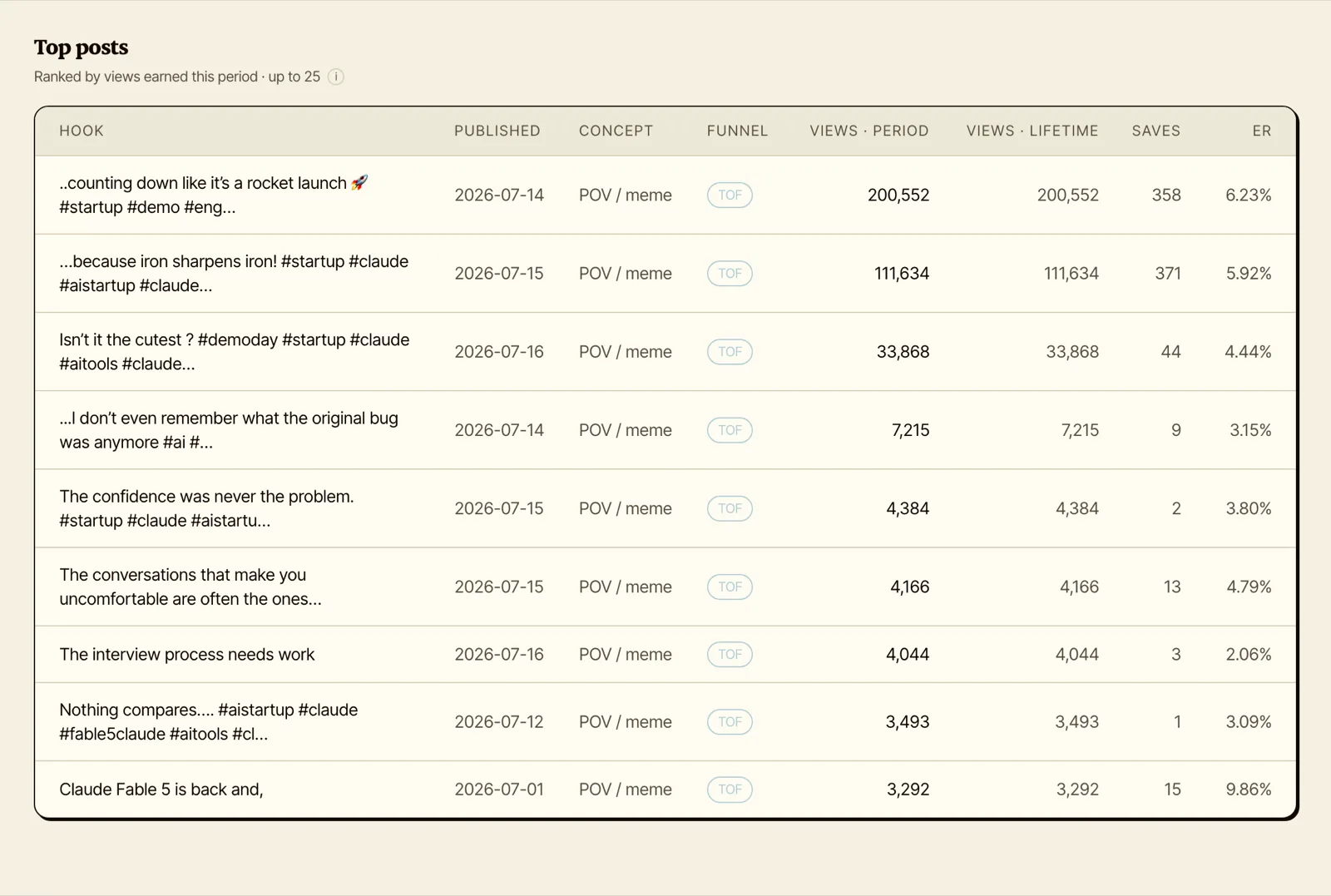
Where the numbers come from. The daily pull runs off the Meta API into the dashboard we built a few issues back, in #006. It has a full funnel page: impressions, followers, every post and its result. The post-level detail is what we layered on top for this, so top posts now show the hook we used, the date published, the concept, whether it's top or bottom of funnel, the views, the saves and the engagement rate. Higher up the same page sit the shoot-this-next recommendations from the weekly sweep.
Every post, ranked, with its editorial DNA attached.
What Claude actually does
It's one setup doing two things: the Claude in Chrome extension, driving Lambert's own browser, logged into his personal Instagram. What changes is when it runs and what it leaves behind.
Once a week it sweeps for what's working in our corner of the platform right now and comes back with angles to try, weighted against the results we already have and the footage we already own. Lambert started that last week, so this week is the first real test of whether the suggestions are any good.
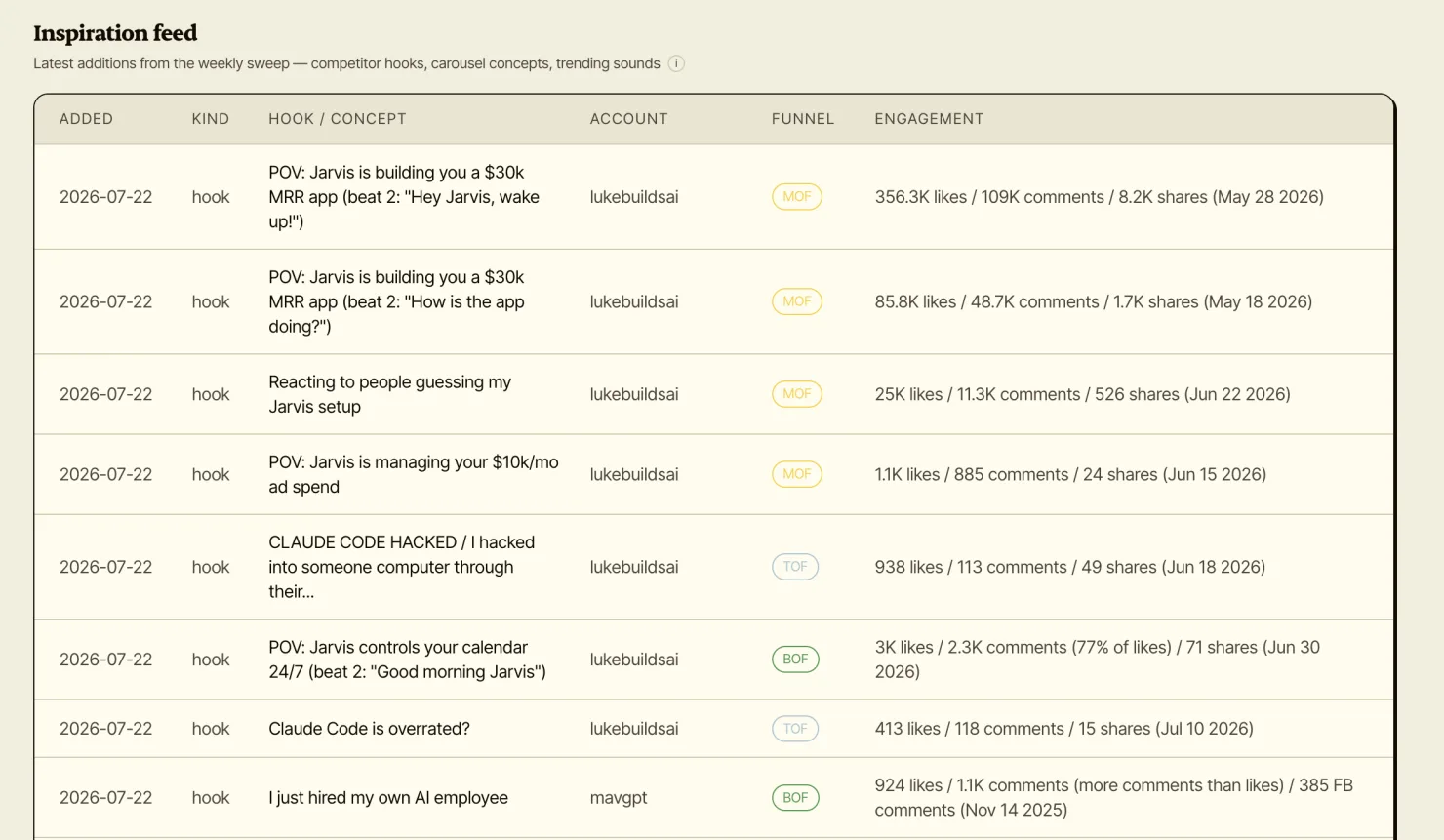
The other pass is the one already earning its keep. A video can be a good idea and still die, and when it does the problem is usually the hook or the edit rather than the concept. So during the hackathon he left Claude browsing for about 4 hours, screenshotting content with high engagement and high view counts, and turned the lot into a CSV: the hook, the post, and how the post performed. The target is 1,000 of them.
Now, when he wants to make a video, he doesn't start from a blank page. He describes the idea and asks Claude what's close in the bank. It answers one of two ways. Either it points him at a hook near enough to adapt, or it says there's nothing there, at which point we go browse and add to it. Either way he's working from what has actually performed in our market over the last 2 or 3 months instead of guessing.
What the bank looks like. It sits on the social page of the same dashboard now, under Inspiration feed.
Why we're not at millions of views
We have the analysis, the trend scan and the bank of hooks, and we're still nowhere near a million views. There are 4 reasons, and then there's what the dashboard says, which doesn't care about any of them.
The data is 1 week old. That's the first and the biggest. Everything above describes a machine we just switched on, and nothing it has produced yet is a pattern.
The process isn't right either. The workflow is as much of a guess as the content is.
The planned content underperforms the unplanned content. This is the one we didn't expect. That shot list from the second hackathon was hard to execute, because filming a specific planned moment means interrupting people who are trying to work. The reels that did best were the ones where someone grabbed a camera on a random idea and caught something real. We have a lot of footage with that human quality now, and it's consistently the footage that travels.
The accounts are cold. We still need to show Instagram that people watch and engage with what we post before it will push anything hard.
Instagram spiked. TikTok is grinding. Here's what each account earned per week over the last 8 weeks. It's a log scale, because 6 views and 379,848 views don't share an axis any other way.
Instagram earned 379,848 views in the hackathon week alone, against 1,671 to 8,087 in each of the 5 weeks before it. The week after was 58,342, still 7 times any pre-hackathon week, so the spike left a tail rather than just spiking. TikTok did 6 views in the week to 6 July and 11,792 in the week to 27 July. The gap between the two accounts was 89 times in the hackathon week and is 5 times now, and it's closing from the TikTok end. Same footage behind both, and most of the time the same cut.
The same upload on both accounts. Posted the same afternoon.
200,552 against 514, and nothing differed but the platform.
The shaded week is the hackathon, and it produced the reel above plus a second at 111,634 and a third at 33,868, all posted within 3 days of each other. Followers moved with it: 117 on 14 July, 254 by the 21st. Instagram's trailing 28-day figure right now is 447,351 views and 266,858 accounts reached. That's Lo's week, the one #008 counted at roughly 400K views and 10 sign-ups. The system described in this issue didn't produce those numbers. It was built the week after them.
Every TikTok we've posted lands in the same band. Here are all 67, bucketed by lifetime views.
The worst performer has 11 views, the median has 317, and the best we have ever managed is 1,774. Nothing is dead. Nothing escapes either. 57 of the 67 land somewhere between 100 and 999 views, so something is holding every post at the same ceiling regardless of what we put into it. Total lifetime views across the whole TikTok account are 31,207. One Instagram reel did 6 times that on its own.
The one lever that has moved TikTok is volume. We went from 24 posts to 67 in the 15 days to 27 July, and weekly views went from 6 to 11,792. No single post broke out doing it, the best is still 1,774. There are just nearly 3 times as many of them sitting in the same band.
Lambert has talked it through with Lo and read everything he can find, and neither of us can tell you what TikTok wants from us.
Then the number that matters: no paying users. It's currently 0. Some of that is fair, since the product is in beta, but I'm not going to file it under "too early" and move on. Getting paying users out of social is the whole point of the channel.
There are agencies that will promise you a 10K or 20K follower account inside a month, and they might even deliver it. We're not social specialists, so we're doing the slower thing: learn what works for us specifically, and buy ourselves enough time to collect the data that shows us what that is.
What's next
Lo keeps the top of funnel. She's going after the million-view video, and she has a better shot at it than we do.
Lambert and I take middle and bottom. This is the harder half, because a random video about your product is a retention problem waiting to happen. Nobody cares. So the first thing we're trying is the "do it with Claude" feature I built at the hackathon (the story is in #008), because it lands on both sides of the audience at once: the people who don't use AI at all and the people who live in it. The angle Lambert wants to test is brain rot with the product inside it. Someone finishes a call with their boss, clicks do it with Claude, and runs straight to the pool while it writes the prompt.
We also want to work out carousels, which do well for accounts with a real follower base. We don't have one yet. At 2K or 3K it gets easier, so we'll build a few and see. Same for stories, which need more followers than we have to be worth the effort.
I want faces on the channel. My argument, which Lambert agrees with: right now most of what we post is editing and b-roll of us working, so it's inspirational but the profile doesn't tell a story when you look at it as a whole. I want employee-led and founder-led content, me and Lambert and David talking to camera. Skits and jokes, but also what we're doing to grow Kai and what Kai actually does. People follow creators because people like humans, and if someone joins early enough to watch Kai go from here to whatever it is in 5 years, that attachment is worth more than any single viral reel.
And then the automation problem. The goal is one content format we can reproduce with Claude at different angles, using our own footage, so the human effort goes into the pieces only a human can make. It's harder than it sounds. There's no usable connection into Edits on Instagram or CapCut on TikTok, so the editing step doesn't automate cleanly. Lambert spent 2 or 3 weeks building a flow for the use-case content on the website, and the flow works but the output isn't good enough to post.
The missing piece is that we have roughly 200 videos and Claude has no idea what's in any of them. So the next job is unglamorous: write a script for each one, name it properly, and give the model enough to pick the right clip, cut it at the right moment and drop the sound on. Once that exists we can produce a lot more and analyse a lot more, and Lambert can spend his time on the content that needs a person.
The goal for the next month is unchanged: acquisition from social, and our first paying users out of it, before the September 1 launch.
If you want to follow along, the whole series lives at How We Grow, and the changelog is the receipts of what we ship week to week. Sign up and each issue lands in your inbox, along with early access to what we're building.

What to read next

The Lab Behind Our Instagram
Issue #018 of How We Grow: the content lab Lambert built behind our Instagram. 800 clips Claude tags second by second, reels Claude edits from them, every idea tested 3 ways on people who don't follow us, and why 570,113 views haven't been turned into customers yet.
One Year of Building With AI
Issue #016 of How We Grow: Jim's first year at Morgen, told through the models we built with, what each new one changed, and how the growth job looks when one person can ship a project in a day.
How We Built Onboarding Emails With Claude
Issue #015 of How We Grow: the 6 onboarding emails Lambert built for Kai, where their content came from, how Claude built them in Intercom without anyone clicking through it, and what the first numbers say.